




Jing Wan Hong
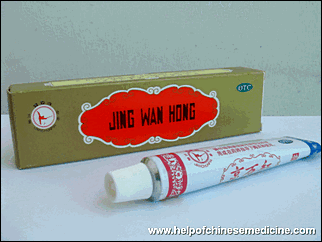
Chinese name:
Ching Wan Hung, Jing Wan Hong (ching wahn huhng)
Capital Absolute Red, Traditional Chinese Burn Cream
Indications:
Burns of all kinds
Functions:
Clears heat, relieves pain, promotes healing
Dosage:
Apply the cream, then cover the burn with a dressing, change daily
Contains 20 g
Manufacturer:
Tianjin Lerentang brand
Description:
Without a doubt, this miracle cream has a welcome place in any first-aid kit. Its ability to heal burns quickly is almost beyond belief. Jing Wan Hong can be applied to first and second degree burns as long as there is no infection. As soon as the ointment comes in contact with the skin, the pain begins to recede. In China, it is used for burns caused by hot water or steam, chemicals, radiation, and sunburn.
We can guarantee that the natural products from ShenYi Center of Chinese Medicine are 100% authentic and our prices are competitive in comparison to other herbal stores.
We ship via Hong Kong post.
Paypal and credit cards accepted. Most of the orders areshipped within 24 hours.
Please contact us for any enquiries:
info (at) helpofchinesemedicine.com


Chinese Medicine Category
- Chinese Medicine for cardiovascular diseases and heart
- Chinese Medicine for gastro-intestinal disorders (poor appetite, indigestion, gastritis, diarrhea)
- Chinese Medicine for men (prostatitis, impotence etc.)
- Chinese Medicine for women (gynecological conditions, pre-menstrual syndrome, infertility)
- Chinese Medicine for liver syndromes (fatty liver, hepatitis)
- Chinese Medicine skin diseases (swelling, eczema, psoriasis)
- Chinese Medicine for asthma, bronchitis, chronic coughs
- Chinese Medicine for rheumatism, arthritis, osteoarthritis
- Chinese Medicine for hypertension
- Chinese Medicine for allergies
- Chinese Medicine for common cold and flu, sore throat
- Chinese Medicine for pain relieve
- Chinese Medicine for fatigue syndrome
- Chinese Medicine for weight loss
Jing Wan Hong Medicine Researches
Preliminary study on the improvement of wound microcirculation and retrospection on several methods of the management of deep partial thickness burn wound
Sun YH, Yu DN, Chen X, Hu XH, Zhang GA, Yan RY, Tan FJ.
Department of Burns, Jishuitan Hospital of Beijing, Beijing 100035, P.R. China.
OBJECTIVE: To analyze several methods of wound repair for deep partial thickness burn wounds retrospectively, so as to evaluate the significance of improvement of wound microcirculation on wound healing. METHODS: (1) 2,976 burn patients admitted to our department were enrolled in the study, among them 614 undertook tangential excision, 32, eschar abrasion, 86 allo-skin coverage after debridement, 1836 tropical application of silver sulfadiazine and 408 with traditional Chinese medicine (Jing Wan Hong ointment) with gauze bandage. The results of the management with different methods were compared. (2) Rat model with deep partial thickness burn was reproduced and topical application of silver sulfadiazine was given. The rats were randomly divided into control (n = 10, with normal saline injected via caudal vein within 5 minutes postburn), and treatment (n = 10, with batroxobin injected via caudal vein within 5 minutes postburn) groups. The blood flow perfusion unit in the wound skin was measured before burn and at 0.5 to 72 postburn hours by Laser Doppler. The wound healing rate, contraction rate and wound healing time in each group were calculated on 14 and 18 postburn days (PBDs). The number of hair follicles after wound healing was observed by histological method. RESULTS: (1) The burn wound treated by tangential excision healed within 2 to 3 post operation weeks (POWs), with the healing rate of 94.8% in patients with burn covering 50% - 70% TBSA and 93.4% in those with burn of 80% approximately 98% TBSA. The healing time of patients with allo-grafts coverage after eschar abrasion was 13.8 +/- 2.1 days without scar formation. The wound healing time was 18.0 +/- 2.3 day in 82 patients with allo-graft coverage after debridement, and it was 26.0 +/- 3.2 days with subeschar healing in 1658 patients with topical application of silver sulfadiazine. Infection in burn wound was encountered in most patients undergoing traditional Chinese medicine bandage treatment with wound healing time of 26.0 +/- 2.8 days in the lower extremities. (2) The blood flow perfusion unit of the rats in the treatment group was significantly higher than that in the control group (P < 0.01). The wound healing rate in treatment group on 14 and 18 PBD was obviously higher than that in the control group (P < 0.01). But the wound contraction rate in the two groups was similar (P > 0.05). The wound healing time ised Jing Wan Hong in treatment group was much shorter than that in control group (P < 0.01). A few hair follicles remained in the dermis of the rats in the control group on 30 PBD, and the number was evidently smaller than that in the treatment group (P < 0.01). CONCLUSION: Early tangential excision and eschar abrasion remained better methods in the management of deep partial thickness burn wounds, as they could ameliorate burn wound infection, shorten treatment period, raise wound healing rate and quality. Application of batroxobin could accelerate wound healing rate by improving wound microcirculation in deep partial thickness burn wound. This is the page of Chinese medicine for burns healing, you can buy Jing Wan Hong online here.
Sun YH, Yu DN, Chen X, Hu XH, Zhang GA, Yan RY, Tan FJ.
Department of Burns, Jishuitan Hospital of Beijing, Beijing 100035, P.R. China.
OBJECTIVE: To analyze several methods of wound repair for deep partial thickness burn wounds retrospectively, so as to evaluate the significance of improvement of wound microcirculation on wound healing. METHODS: (1) 2,976 burn patients admitted to our department were enrolled in the study, among them 614 undertook tangential excision, 32, eschar abrasion, 86 allo-skin coverage after debridement, 1836 tropical application of silver sulfadiazine and 408 with traditional Chinese medicine (Jing Wan Hong ointment) with gauze bandage. The results of the management with different methods were compared. (2) Rat model with deep partial thickness burn was reproduced and topical application of silver sulfadiazine was given. The rats were randomly divided into control (n = 10, with normal saline injected via caudal vein within 5 minutes postburn), and treatment (n = 10, with batroxobin injected via caudal vein within 5 minutes postburn) groups. The blood flow perfusion unit in the wound skin was measured before burn and at 0.5 to 72 postburn hours by Laser Doppler. The wound healing rate, contraction rate and wound healing time in each group were calculated on 14 and 18 postburn days (PBDs). The number of hair follicles after wound healing was observed by histological method. RESULTS: (1) The burn wound treated by tangential excision healed within 2 to 3 post operation weeks (POWs), with the healing rate of 94.8% in patients with burn covering 50% - 70% TBSA and 93.4% in those with burn of 80% approximately 98% TBSA. The healing time of patients with allo-grafts coverage after eschar abrasion was 13.8 +/- 2.1 days without scar formation. The wound healing time was 18.0 +/- 2.3 day in 82 patients with allo-graft coverage after debridement, and it was 26.0 +/- 3.2 days with subeschar healing in 1658 patients with topical application of silver sulfadiazine. Infection in burn wound was encountered in most patients undergoing traditional Chinese medicine bandage treatment with wound healing time of 26.0 +/- 2.8 days in the lower extremities. (2) The blood flow perfusion unit of the rats in the treatment group was significantly higher than that in the control group (P < 0.01). The wound healing rate in treatment group on 14 and 18 PBD was obviously higher than that in the control group (P < 0.01). But the wound contraction rate in the two groups was similar (P > 0.05). The wound healing time ised Jing Wan Hong in treatment group was much shorter than that in control group (P < 0.01). A few hair follicles remained in the dermis of the rats in the control group on 30 PBD, and the number was evidently smaller than that in the treatment group (P < 0.01). CONCLUSION: Early tangential excision and eschar abrasion remained better methods in the management of deep partial thickness burn wounds, as they could ameliorate burn wound infection, shorten treatment period, raise wound healing rate and quality. Application of batroxobin could accelerate wound healing rate by improving wound microcirculation in deep partial thickness burn wound. This is the page of Chinese medicine for burns healing, you can buy Jing Wan Hong online here.
