




Herbs that strengthen the Qi include Renshen (Panax ginseng), Huangqi (Radix astralagus), Baizhu (Atractylodes macrocephala), Dangshen (Codonopsis pilosula), Shanyao (Dioscorea opposita), Lingzhi (Ganoderma lucidum), Dazao (Ziziphus jujuba), Zhigan Cao (Glycyrrhiza glabra).
Shenyi Center of Chinese medicine has a large variety of Chinese medicine for fatique to choose from
click here
- Chinese Medicine for cardiovascular diseases and heart
- Chinese Medicine for gastro-intestinal disorders (poor appetite, indigestion, gastritis, diarrhea)
- Chinese Medicine for men (prostatitis, impotence etc.)
- Chinese Medicine for women (gynecological conditions, pre-menstrual syndrome, infertility)
- Chinese Medicine for liver syndromes (fatty liver, hepatitis)
- Chinese Medicine skin diseases (swelling, eczema, psoriasis)
- Chinese Medicine for asthma, bronchitis, chronic coughs
- Chinese Medicine for rheumatism, arthritis, osteoarthritis
- Chinese Medicine for hypertension
- Chinese Medicine for allergies
- Chinese Medicine for common cold and flu, sore throat
- Chinese Medicine for pain relieve
- Chinese Medicine for fatigue syndrome
- Chinese Medicine for weight loss
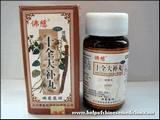
Modern studies has releaved that Shi Quan Da Bu Wan has immunopotentiating effects, potentates therapeutic activity in chemotherapy and radiotherapy, inhibits the recurrence of malignancies, prevents adverse toxicities of many anticancer drugs.
Dosage: 8-10 pills per time, three times per day, contains 200 pills
Manufacturer: Langzhou Foci
Read more...
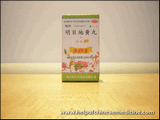
Ming Mu Di Huang Wan natural medicine.
It is an excellent all around eye Chinese herbal formula for improving eyesight. It helps to treat poor vision, dry eyes, photophobia, red, irritated, and itchy eyes, excessive tearing and night blindness. Symptoms get worse with overuse of eyes. This formula can be used to treat glaucoma, cataracts, optic neuritis, retinitis, Sjogren's bbbbsyndrome, myopia, and atrophy of optic nerve.
Dosage: 8 pills each time, 3 times per day, contains 200 pills
Manufacturer: Anhui Tian Mu Pharmaceutical Co.
Read more...
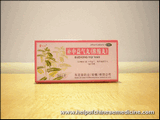
Symptoms include blurry vision, dry and painful eyes, pressure behind the eyes, and poor night vision.
Also applicable for dizziness, headaches, pain behind eyes, outbursts of anger, heat in palms, restlessness and insomnia.
Dosage: 6 gram per time, 2 times per day, contains 200 pills (36 g)
Manufacturer: Hubei Liang Hu Brand
Read more...
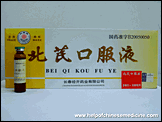
A safe and effective herb, it strengthens the immune system by increasing production of antibodies and macrophages, cells that attack disease-causing pathogens and foreign objects in the body.
Dosage: taken orally one vial(10 ml) per time, two times per day, contains 10 vials
Manufacturer: Changchun Xiang Yang Brand
Read more...
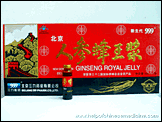
With its warm energy, it is especially appropriate for weak, cold individuals who have both qi deficiency and yang deficiency. Symptoms of this deficiency condition include fatigue, low immunity, pale face and tongue, and feeling cold all the time. It has a significant ability to reduce fatigue and strengthen the immune system.
Dosage: orally once or twice per day, 10-20 ml each time
Manufacturer: Beijing 999 Pharm. Co.
Read more...
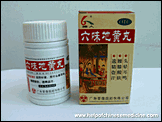
This is the classical base formula for all conditions of yin deficiency, especially of the liver and kidneys. Some of the disorders Liu Wei Di Huang Wan treats are diabetes, tuberculosis, hyperthyroidism, nephritis, hypertension, chronic urinary tract infection, and various degenerative diseases of the eyes. With some conditions, such as tuberculosis, Western pharmaceuticals are taken along with the herbs.
Dosage: 6g or 30 pills, two times per day, bottle contains 54g or 270 pills
Manufacturer: Guangdong Lightning Chinese Medicine Co.
Read more...
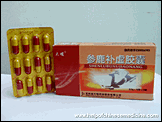
Dosage: 3 capsules per time, two times per day, 36 capsules
Manufacturer: Jilin Dajun Pharmaceutical Co.
Read more...
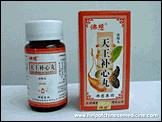
This ancient formula in patent form is the classical remedy for the symptoms of "heart and kidney yin deficiency," an imbalance common in modern industrialized society.
Symptoms include insomnia with restless sleep, disturbing dreams, anxiety, forgetfulness, mouth sores, inability to concentrate, and, possibly, night sweats. From a Western perspective, it can be used for mental or emotional disorders, insomnia, hypertension, menopause, or hyperthyroidism.
Dosage:one time 8 pills, 3 times per day, contains 200 pills
Manufacturer: Langzhou Foci
Read more...
Effects of traditional Chinese medicine on immune responses in abalone, Haliotis discus hannai Ino.
Xue J, Xu Y, Jin L, Liu G, Sun Y, Li S, Zhang J.
Department of Bioscience and Biotechnology, Dalian University of Technology, Dalian 116024, PR China.
A traditional Chinese medicine (TCM) preparation was formulated from orange peel (Pericarpium Citri Reticulatae), hawthorn (Crataegus pinnatifida), astragalus (Astragalus membranaceus (Fisch.) Bunge), pilose asiabell root (Radix codonopsis), indigowoad root (Radix isatidis), taraxacum (Herba taraxaci) and malt (Fructus Hordei Germinatus) at a weight ratio of 1:1:1.5:1.5:1.5:1.5:2. A feeding experiment was conducted to determine the effects of TCM, Chinese medicine for fatique on innate immunity of abalone, Haliotis discus hannai Ino. Artificial diets containing 1%, 3%, 5% TCM preparation, 1% hawthorn or 1% astragalus, respectively, were fed to juvenile abalone (initial weight 10.38+/-2.51g; initial shell length 44.15+/-4.15mm) for 80 days. A TCM-free diet was used as a control. Each diet was fed to three replicate groups of abalone using a randomized design. The results indicated that phagocytic activity was significantly higher in abalone fed 3%, 5% TCM preparation, 1% astragalus or 1% hawthorn (P<0.05). Respiratory burst activity was significantly higher in abalone fed 1%, 3%, 5% TCM preparation, 1% astragalus or 1% hawthorn (P<0.05). Agglutination titre was significantly higher in abalone fed 5% TCM preparation (P<0.05). Weight gain ratio (WGR), daily increment in shell length (DISL), total haemocyte count (THC), plasma protein concentration, and the activity of acid phosphatase (ACP) were not significantly affected by the TCM preparation (P>0.05) Chinese medicine for fatique. These results indicate that TCM preparation can modulate the immunity of H. discus hannai, and it is very possible that TCM might be used as immunostimulants in abalone farming.
Autoantibody Profiling of Chinese Patients with Autoimmune Hepatitis Using Immunoproteomic Analysis.
Xia Q, Lu F, Yan HP, Wang HX, Feng X, Zhao Y, Liu BY, Wang J, Li P, Xue Y, Hu MR, Qian L, Guo N, Yang SC, Li MY, Ma YF, Li BA, Zhang XM, Shen BF.
Department of Molecular Immunology, Institute of Basic Medical Sciences, Taiping Road 27, Beijing 100850, China, Central Laboratory, Beijing Youan Hospital, Capital University of Medical Sciences, Beijing 100069, China, National Center of Biomedical Analysis, Taiping Road 27, Beijing 100850, China, Department of Cellular & Molecular Immunology, Medical School of Henan University, Kaifeng 475004, China, School of Preclinical and Forensic Medicine, West China Medical Center of Sichuan University, Chengdu 610041, China, and Center of Clinical Laboratory, 302 Hospital, Beijing 100039, China
In the present study, immunoproteomic analysis was utilized to systemically characterize global autoantibody profiles in autoimmune hepatitis (AIH). Sera from 21 patients with AIH and 15 healthy controls were analyzed for the antibody reactivity against the protein antigens of HepG2, a human hepatoma cell line. The lysates of HepG2 cells were separated by two-dimensional electrophoresis and then immunoblotted with each serum sample. Matrix-assisted laser desorption/ionization mass spectrometry or/and nanoelectrospray ionization MS/MS were then used to identify antigens, among which a bifunctional enzyme in mitochondrial, fumarate hydratase (FH), was further analyzed by ELISA using recombinant FH as a coating antigen. A total of 18 immunoreactive spots were identified as 13 proteins, 8 of which have not been reported in AIH. Immune reactivity to FH was detected in 66.67% of patients with AIH, 19.35% of patients with primary biliary cirrhosis (PBC), 12.31% of patients with chronic hepatitis B (CHB), 6.35% of patients with chronic hepatitis C (CHC), 11.32% of patients with systemic lupus erythematosus (SLE), and 3.57% of normal individuals. The differences of prevalence between AIH patients and healthy controls as well as other diseases were of statistical significance ( P < 0.001). These data demonstrate the serological heterogeneity in AIH and suggest the diversity of the mechanisms underlying AIH. FH, recognized mainly in AIH rather than in viral hepatitis and other autoimmune diseases, may have utility in improved diagnosis of AIH.
Here you can buy online Chinese medicine for fatique syndrome
