




Shenyi Center of Chinese medicine has a variety of Chinese medicines for women click here
- Chinese Medicine for cardiovascular diseases and heart
- Chinese Medicine for gastro-intestinal disorders (poor appetite, indigestion, gastritis, diarrhea)
- Chinese Medicine for men (prostatitis, impotence etc.)
- Chinese Medicine for women (gynecological conditions, pre-menstrual syndrome, infertility)
- Chinese Medicine for liver syndromes (fatty liver, hepatitis)
- Chinese Medicine skin diseases (swelling, eczema, psoriasis)
- Chinese Medicine for asthma, bronchitis, chronic coughs
- Chinese Medicine for rheumatism, arthritis, osteoarthritis
- Chinese Medicine for hypertension
- Chinese Medicine for allergies
- Chinese Medicine for common cold and flu, sore throat
- Chinese Medicine for pain relieve
- Chinese Medicine for fatigue syndrome
- Chinese Medicine for weight loss
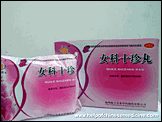
Millions of Chinese women have used this ancient herbal formula regularly to tonify the blood, replenish energy, reduce fatigue and improve the appetite. Useful for dizziness, irregular menstruation, hypoglycemia, recovery from childbirth and illness.
Dosage: 10 packets, 1 packet per time, 2 times per day
Manufacturer: Fuzhou Haiwang
Read more...
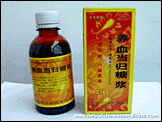
A Classic Chinese tonic, it helps symptoms of dizziness, palpitations, poor memory. Good for irregular menstruation or postpartum weakness due to loss of blood.
Often used along with Women's Precious Pills, Nu Ke Ba Zhen Wan.
Dosage: 10 ml orally each time, 3 times per day, bottle contains 200 ml
Manufacturer: Jiangxi Nangda
Read more...
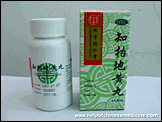
This Chinese formula is very useful in treating the symptoms of menopause, where the deficiency of yin (estrogen) leads to deficiency heat (hot flashes, night sweats, restlessness). It is also effective in treating the same symptoms in people who have developed deficiency heat signs after long-term use of thyroid replacement hormones or lithium.
Dosage: Take 6g (30 pills), 2 times a day, contains 360 pills
Manufacturer: Beijing Tong Ren Tang
Read more...
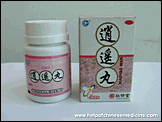
Xiao Yao Wan is the most commonly used formula for moving blocked Liver qi, strengthening the Spleen, and nourishing blood. Beneficial for pains or distension in the side, headache, fatigue, moodiness, irregular menstruation, and other liver energy stagnation symptoms. This formula was first recorded in 1151AD.
Dosage: 3/4 of cap or full cap each time(6-9g), 1-2 times per day, bottle contains 36g
Manufacturer: Guangzhou Jing Xiu Tang Pharmaceutical Co., Ltd
Read more...
Traditional Chinese medicine syndromes in women with frequently recurring cystitis: frequencies of syndromes and symptoms
T. Alrakb, a, A. Aunea and A. Baerheimb
a Bryggen Medical Centre, Bergen, Norway
b Section for General Practice, Department of Public Health and Primary Health Care, University of Bergen, Norway
Background: Frequently recurrent acute cystitis in adult women is common in Western medicine. In prophylactic treatment, women are treated between attacks of acute cystitis to prevent recurrences. A recent study has shown that acupuncture seems effective for prophylaxis. Objectives: To describe the frequency of traditional Chinese medicine (TCM) syndromes found in females vulnerable to recurrent cystitis, and which symptoms most often form the basis for TCM diagnoses made in this condition. Methods: A descriptive study based on TCM diagnostic methods as used by experienced acupuncturists, and a questionnaire of symptoms used in TCM diagnostics. Results: Of 61 women with frequently recurring cystitis, 90% were diagnosed as having either a Spleen/Kidney yang xu/qi xu (54%), or a Liver qi stagnation (36%). Only 10% fell in other diagnostic groups. Of all symptoms noted, only three differed in frequency between the two main diagnostic groups: feeling cold (29/33 vs. 13/22, P<0.05), feeling tired (25/33 vs. 4/22, P<0.001), and having a preference for sweets (10/33 vs. 2/22, P<0.05). Conclusion: Our findings have implications for TCM-based diagnostic work in females with recurrent cystitis, and also indicate that recurrent cystitis may be used as a case for further TCM research.
Application of traditional Chinese medicine in the treatment of infertility.
Xu X, Yin H, Tang D, Zhang L, Gosden RG.
The Jones Institute for Reproductive Medicine, Department of Obstetrics and Gynaecology, Norfolk, VA 23507, USA.
The philosophy and practice of traditional Chinese medicine (TCM) have been evolving for thousands of years in China, Japan and other Asian countries. TCM is now generating popular interest worldwide for reproductive health care and disease prevention, including applications for treating infertility and improving sexual function. This review focuses on the application of TCM for infertility patients, and provides a critical reflection on the efficacy and safety of selected Chinese herbal formulas. It has been claimed that some formulas produce high clinical pregnancy rates with few or no side effects, as well as improving the general well-being of patients. The need for randomized control trials and research into possible mechanisms of action, effective doses, contra-indications and toxicity is self-evident. However, the task is enormous in view of the number of herbal products currently available on the market; yet among these products are undoubtedly some that will prove to be safe and beneficial.
The improvement of luteal insufficiency in fecund women by tokishakuyakusan treatment.
Usuki S, Higa TN, Soreya K.
Department of Obstetrics and Gynecology, Institute of Clinical Medicine, University of Tsukuba, Ibaraki, Japan.
The effect of tokishakuyakusan, a Chinese herbal medicine, was examined, in vivo, in women with luteal insufficiency and in women with normal menstrual cycles. Luteal insufficiency was determined by daily measurement of basal body temperature and plasma progesterone levels. Tokishakuyakusan improved luteal insufficiency. Furthermore, the effects of tokishakuyakusan on prolactin, gonadotropins, steroids, angiotensin II, ANP and renin levels in the blood of women with normal menstrual cycles were studied, as were the medicine's effects on estrogens, pregnenediol and LH in the urine of the same women. Tokishakuyakusan had no adverse effect on hormonal levels in either blood or urine. Furthermore, no clinical side effects were detected. These results suggest that tokishakuyakusan improves luteal insufficiency in women but does not affect the hormonal levels of women with normal menstrual cycles.
Treatment with hachimijiogan, a non-ergot Chinese herbal medicine, in two hyperprolactinemic infertile women.
Usuki S, Kubota S, Usuki Y.
Department of Obstetrics and Gynecology, Institute of Clinical Medicine, University of Tsukuba, Japan.
Two hyperprolactinemic infertile women, one with and one without a pituitary adenoma, who were resistant to bromocriptine treatment, were treated orally with Hachimijiogan, a Chinese herbal medicine. This treatment reduced the serum prolactin level, resulting in a normal ovulatory cycle and pregnancy, without side effects.
Here you can buy online Chinese medicine for gynaecological conditions, including pre-menstrual syndrome and dysmenorrhoea, endometriosis, infertility
