




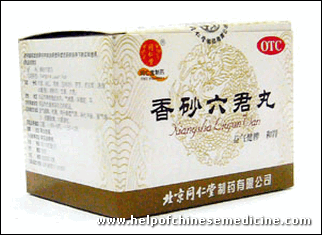
Citrus peel (chen pi) and Pinellia rhizome (ban xia) makes it effective for treating more acute cases of digestive imbalances with nausea, vomiting, and diarrhea. The addition of Saussurea (mu xiang) and cardamon (sha ren) helps to rectify digestive weakness and distress. It is especially appropriate for people who are pale and weak. Xiang Sha Liu Jun Wan can be helpful for treatment of peptic ulcer, chronic gastritis, Crohn's disease, irritable bowel syndrome, morning sickness, and chronic colitis.
We can guarantee that the natural products from ShenYi Center of Chinese Medicine are 100% authentic and our prices are competitive in comparison to other herbal stores.
We ship via Hong Kong post.
Paypal and credit cards accepted. Most of the orders areshipped within 24 hours.
Please contact us for any enquiries:
info (at) helpofchinesemedicine.com


- Chinese Medicine for cardiovascular diseases and heart
- Chinese Medicine for gastro-intestinal disorders (poor appetite, indigestion, gastritis, diarrhea)
- Chinese Medicine for men (prostatitis, impotence etc.)
- Chinese Medicine for women (gynecological conditions, pre-menstrual syndrome, infertility)
- Chinese Medicine for liver syndromes (fatty liver, hepatitis)
- Chinese Medicine skin diseases (swelling, eczema, psoriasis)
- Chinese Medicine for asthma, bronchitis, chronic coughs
- Chinese Medicine for rheumatism, arthritis, osteoarthritis
- Chinese Medicine for hypertension
- Chinese Medicine for allergies
- Chinese Medicine for common cold and flu, sore throat
- Chinese Medicine for pain relieve
- Chinese Medicine for fatigue syndrome
- Chinese Medicine for weight loss
Effect of XIANG SHA LIU JUN ZI WAN on electrogastrogram and gastrin in patients with functional dyspepsia
Shenzhen Journal of Integrated Traditional Chinese and Western Medicine 2001
Effect of Wei Dong Ling and Its Decomposited formula(Xiang Sha Liu Jun Zi and Si Ni San) to Gastric Evacuation and Small Intestine's Propulsive Function of Mouse
Journal of Gansu College of Traditional Chinese Medicine 2001
Movement disorders possibly induced by traditional Chinese herbs.
Wang XP, Yang RM.
Laboratory of Neurodegenerative Diseases, School of Life Sciences, University of Science and Technology of China, Hefei, PR China.
The authors describe the neurological presentation and CT/MRI findings in 4 patients exposed to overdoses of decoctions of two different Chinese herbs. Case 1, a 15-year-old boy, ingested herba serissae along with the safe-dosage Salvia miltiorrhiza for treating a left renal stone. Sophora subprostrata root (SSR) was primarily used for treating three other diseases: viral B hepatitis in case 2, a 9-year-old boy; infection of the throat and a low fever in case 3, a 11-year-old girl, and a minor facial infection in case 4, a 12-year-old boy. All patients showed complex neurological manifestations primarily including convulsions, mental changes and dystonia syndromes. Their CT and/or MRI revealed abnormal density lesions in the striatum and globus pallidus bilaterally. They excluded the possibility of Wilson's disease in each of the 4 patients and suggested that overdosage of SSR and herba serissae could cause intoxications of the central nervous system, particularly damage to the basal ganglia. Chemically, coumarin (case 1) and matrine and oxymatrine (cases 2-4) in the two medicinal herbs are suggested to be possibly responsible for the morbidity.
This is the page of Chinese medicine for gastro-intestinal disorders, you can also buy Xiang Sha Liu Jun Wan online here.
