




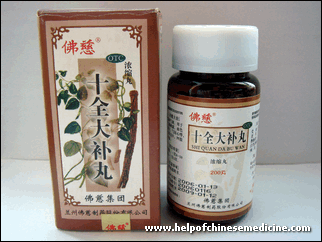
Modern studies has releaved that Shi Quan Da Bu Wan has immunopotentiating effects, potentates therapeutic activity in chemotherapy and radiotherapy, inhibits the recurrence of malignancies, prevents adverse toxicities of many anticancer drugs.
In Japan, pharmacological researches and clinical uses of Shi Quan Da Bu Tang ("Shi Quan Da Bu Wan" in pill form, "Juzen-taiho-to" in Japaness pronunciation) have been extensively carried out. These has resulted in publishing a research monograph of the formula. The review on Chapter 10:
"Chapter 10. Antitumor effects in combination with chemotherapy by K. Tarao and T. Okamoto. This chapter presents clinical effects of the formula as an adjuvant agent in combination with anticancer agents against various cancers including gastric, colorectal, hepatocellular, breast, gynecological, urological and lung. The formula alleviates side-effects resulting from chemotherapy after using 5-fluorouracil, cis-platin, adriamycin, mitomycin and cyclophophamide. It also improves the quality of life of cancer patients."
Shi Quan Da Bu Wan was formulated by Taiping Hui-Min Ju (Public Welfare Pharmacy Bureau)
in Chinese Song Dynasty in AD 1200.
We can guarantee that the natural products from ShenYi Center of Chinese Medicine are 100% authentic and our prices are competitive in comparison to other herbal stores.
We ship via Hong Kong post.
Paypal and credit cards accepted. Most of the orders areshipped within 24 hours.
Please contact us for any enquiries:
info (at) helpofchinesemedicine.com


- Chinese Medicine for cardiovascular diseases and heart
- Chinese Medicine for gastro-intestinal disorders (poor appetite, indigestion, gastritis, diarrhea)
- Chinese Medicine for men (prostatitis, impotence etc.)
- Chinese Medicine for women (gynecological conditions, pre-menstrual syndrome, infertility)
- Chinese Medicine for liver syndromes (fatty liver, hepatitis)
- Chinese Medicine skin diseases (swelling, eczema, psoriasis)
- Chinese Medicine for asthma, bronchitis, chronic coughs
- Chinese Medicine for rheumatism, arthritis, osteoarthritis
- Chinese Medicine for hypertension
- Chinese Medicine for allergies
- Chinese Medicine for common cold and flu, sore throat
- Chinese Medicine for pain relieve
- Chinese Medicine for fatigue syndrome
- Chinese Medicine for weight loss
Surface expression of toll-like receptor 4 on THP-1 cells is modulated by Bu-Zhong-Yi-Qi-Tang and Shi-Quan-Da-Bu-Tang.
Mita Y, Dobashi K, Shimizu Y, Nakazawa T, Mori M.
First Department of Internal Medicine, Gunma University Faculty of Medicine, Gunma, Japan.
Human Toll-like receptor 4 (TLR4) has recently been identified and has been shown to be the main protein involved in recognizing Gram-negative bacteria. We examined the regulation of TLR4 surface expression in a human monocytic cell line (THP-1 cells) by two traditional Chinese herbal medicines. Bu-Zhong-Yi-Qi-Tang (TJ-41) and Shi Quan Da Bu Wan (TJ-48). TJ-41 and TJ-48 upregulated TLR4 surface expression in THP-1 cells, as well as enhanced TLR4 surface expression in these cells both dose- and time-dependently. These findings suggest that TJ-41 and TJ-48 increase the receptor involved in the response to Gram-negative bacteria and may enhance defenses against these pathogens. Effects of Erkang, a modified formulation of Chinese folk medicine Shi Quan Da Bu Wan, on mice.
Wu Y, Zhang Y, Wu JA, Lowell T, Gu M, Yuan CS.
Institute of Cancer Medicine, Harbin Medical University, People's Republic of China.
Shi Quan Da Bu Wan is a traditional Chinese herbal medicine formula used to increase vital energy, and strengthen health and immunity. Data from previous studies demonstrated that this formula also has the ability to attack tumor tissue. The Erkang capsule is a modified formula of Shi Quan Da Bu Wan, with the addition of four other herbs to increase the adaptogen effects and ergogenic properties. Results from this study in mice indicated that the Erkang treated group had significant differences in mortality, body weight change, fatigue, cold temperature endurance, and immune function related organ weight change, compared to the control animals.
Inhibition by Shi Quan Da Bu Wan(TJ-48) of experimental hepatocarcinogenesis induced by N-nitrosomorpholine in Sprague-Dawley rats.
Tatsuta M, Iishi H, Baba M, Nakaizumi A, Uehara H.
Department of Gastrointestinal Oncology, Center for Adult Diseases, Osaka, Japan.
The effect of Shi Quan Da Bu Wan (TJ-48) on hepatocarcinogenesis induced by N-nitrosomorpholine (NNM) was investigated in male Sprague-Dawley rats. Rats were given drinking water containing NNM for 8 weeks, and also from the start of the experiment, regular chow pellets containing 2.0 or 4.0% TJ-48 until the end of the experiment. Preneoplastic and neoplastic lesions staining for the placental type of glutathione-S-transferase (GST-P) or gamma-glutamyl transpeptidase (GGT) were examined histochemically. In week 15, quantitative histological analysis showed that prolonged administration of either 2.0 or 4.0% TJ-48 in the diet significantly reduced the size, volume and/or number of GST-P-positive and GGT-positive hepatic lesions. This treatment also caused a significant increase in the proportion of interleukin-2 receptor-positive lymphocytes among the lymphocytes infiltrating the tumours as well as a significant decrease in the labelling index of preneoplastic lesions. These findings indicate that TJ-48 inhibits the growth of hepatic enzyme-altered lesions, and suggests that its effect may be in part due to activation of the immune system
Shi Quan Da Bu Wan (ten significant tonic decoction), SQT. A potent Chinese biological response modifier in cancer immunotherapy, potentiation and detoxification of anticancer drugs.
Zee-Cheng RK.
Department of Pharmacology, Toxicology, and Therapeutics, University of Kansas Medical Center, Kansas City.
Shi Quan Da Bu Wan(Ten Significant Tonic Decoction), or SQT (Juzentaihoto, TJ-48) was formulated by Taiping Hui-Min Ju (Public Welfare Pharmacy Bureau) in Chinese Song Dynasty in AD 1200. It is prepared by extracting a mixture of ten medical herbs (Rehmannia glutinosa, Paeonia lactiflora, Liqusticum wallichii, Angelica sinesis, Glycyrrhiza uralensis, Poria cocos, Atractylodes macrocephala, Panax ginseng. Astragalus membranaceus and Cinnamomum cassia) that tone the blood and vital energy, and strengthen health and immunity. This potent and popular prescription has traditionally been used against anemia, anorexia, extreme exhaustion, fatigue, kidney and spleen insufficiency and general weakness, particularly after illness. In order to restore immunity in cancer patients, potentiate the therapeutic effect and ameliorate adverse toxicity of anticancer agents, 116 Chinese herbal formularies (Kampo) have been screened and evaluated. Fifteen compounds were found to have such actions. Among these, SQT was selected as the most effective as a potent biological response modifier. During the last eight years, animal models and clinical studies have revealed that Shi Quan Da Bu Wan demonstrates extremely low toxicity (LD50 > 15 g/kg op murine), self-regulatory and synergistic actions of its components in immunomodulatory and immunopotentiating effects (by stimulating hemopoietic factors and interleukins production in association with NK cells, etc.), potentiates therapeutic activity in chemotherapy (mitomycin, cisplatin, cyclophosphamide and fluorouracil) and radiotherapy, inhibits the recurrence of malignancies, prolongs survival, as well as ameliorate and/or prevents adverse toxicities (GI disturbances such as anorexia, nausea, vomiting, hematotoxicity, immunosuppression, leukopenia, thrombocytopenia, anemia and nephropathy, etc.) of many anticancer drugs. The application and mechanistic studies of SQT in future development have potential importance in basic and clinical research of the traditional Chinese therapeutic approach of "toning the blood and strengthening Qi (vital energy)" in cancer immunotherapy.
Combination Effects of Herbs in a Multi-herbal Formula: Expression of Shi Quan Da Bu Wan Immuno-modulatory Activity on the Intestinal Immune System.
Kiyohara H, Matsumoto T, Yamada H.
Kitasato Institute for Life Sciences, Kitasato University, Tokyo, Japan.
Herbal formulas of traditional Japanese (Kampo), Chinese and Korean medicines usually comprise multiple herbs in a single formula. These medicines are expected to show their clinical effects by chemical, pharmacological and pharmaceutical combination effects of multi-herbs. However, little effort has been made so far to scientifically clarify the nature of such combination effects. Interestingly, for example, though a Kampo medicine Juzen-taiho-to (Shi Quan Da Bu Wan in Chinese) stimulates the immune functions of Peyer's patch cells, none of its single component herbs shows such activity. We thus examined the combination effect of herbs in the Juzen-taiho-to formula for the expression of its immuno-stimulating activity. Shi Quan Da Bu Wan, a composite formula of 10 herbs, has been generally considered to comprise two kinds of basic formula, each of which consists of four different herbs in addition to two others. The combinations of herbs based on these two basic formulas were evaluated for their stimulating activities on cytokine production from murine Peyer's patch cells both in vitro and ex vivo. Combined decoction of six among 10 herbs in Juzen-taiho-to is crucial for the expression of its stimulating activity on Peyer's patch cells. 3D-HPLC analysis of the ingredients in the fractions from the combined decoctions indicated that, in addition to quantitative changes of ingredients, alterations occur in their chemical composition by decoction of different herbs. The stimulating activity of Shi Quan Da Bu Wan on Peyer's patch cells results from the combination effect of its six essential component herbs. This combination effect is based on physicochemical interactions among the ingredients of the component herbs.
Effects of Japanese herbal medicine, Shi Quan Da Bu Wan, in otitis-prone children - a preliminary study.
Maruyama Y, Hoshida S, Furukawa M, Ito M.
Kurobe City Hospital, Kurobe, Japan.
Conclusion: Shi Quan Da Bu Wan (JTT, TJ-48), a Japanese herbal medicine that improves immune function, was found to be effective in otitis-prone in children.
This is the page of Chinese medicine for cancer problems, you can buy Shi Quan Da Bu Wan online here.
