




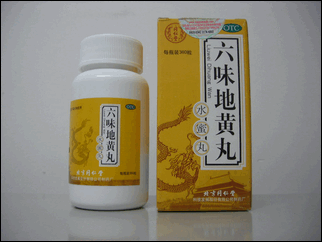
$7.95
Dosage: Take 30 pills each time,
2 times a day, bottle contains 360 pills
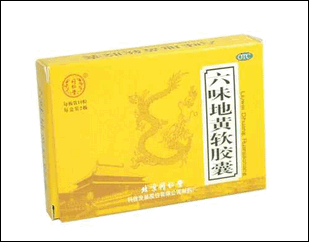
$6.95
Dosage: Take 3 capsules per time,
2 times per day. Contains 20 Capsules
This is the classical base formula for all conditions of yin deficiency, especially of the liver and kidneys. Some of the disorders Liu Wei Di Huang Wan treats are diabetes, tuberculosis, hyperthyroidism, nephritis, hypertension, chronic urinary tract infection, and various degenerative diseases of the eyes. With some conditions, such as tuberculosis, Western pharmaceuticals are taken along with the herbs.
Liu Wei DiHuang Wan is a Chinese Medicine whose formula was 1st listed in the "Craft of Medical Treatment for Childhood Disease Patterns" (Xiao Er Yao Zheng Zhi Jue) by Dr. Qian Yi in 1119 AD.
We can guarantee that the natural products from ShenYi Center of Chinese Medicine are 100% authentic and our prices are competitive in comparison to other herbal stores.
We ship via Hong Kong post.
Paypal and credit cards accepted. Most of the orders areshipped within 24 hours.
Please contact us for any enquiries:
info (at) helpofchinesemedicine.com


- Chinese Medicine for cardiovascular diseases and heart
- Chinese Medicine for gastro-intestinal disorders (poor appetite, indigestion, gastritis, diarrhea)
- Chinese Medicine for men (prostatitis, impotence etc.)
- Chinese Medicine for women (gynecological conditions, pre-menstrual syndrome, infertility)
- Chinese Medicine for liver syndromes (fatty liver, hepatitis)
- Chinese Medicine skin diseases (swelling, eczema, psoriasis)
- Chinese Medicine for asthma, bronchitis, chronic coughs
- Chinese Medicine for rheumatism, arthritis, osteoarthritis
- Chinese Medicine for hypertension
- Chinese Medicine for allergies
- Chinese Medicine for common cold and flu, sore throat
- Chinese Medicine for pain relieve
- Chinese Medicine for fatigue syndrome
- Chinese Medicine for weight loss
Components of Hachimi-jio-gan (Lei-Wei-Di-Huang-Wan) and changes in blood flow in the human central retinal artery
ISOBE Hideyuki 1 YAMAMOTO Kazuhiko 2 CYONG Jong-Chol 3
We found an increase in blood flow in the central retinal artery attributable to Liu Wei Di Huang Wan extract granules, using the latest ultrasonic diagnosis device. A further examination was added concerning the relation between Liu Wei Di Huang Wan components and the increase of blood flow. The decoction of Liu Wei Di Huang Wan produced an increased blood flow in the central retinal artery, as did the extract granules. This increase, however, was not observed in the case of a decoction or extract granules of Rokumi-gan (RG). Central retinal artery exhibited a decrease in vascular resistance after administration of decoctions of Cinnamon Bark and of Aconite Tuber. The increased blood flow in the central retinal artery, however, occurred to a lesser extent with a decoction of 2 crude drugs (Cinnamon Bark and Aconite Tuber) and with a decoction of 7 crude drugs that added Cinnamon Bark or Aconite Tuber to RG (which contains neither Aconite Tuber nor Cinnamon Bark, unlike Liu Wei Di Huang Wan which contains both). It is suggested that the cause of increased blood flow in the central retinal artery attributable to Liu Wei Di Huang Wan is shown by the result, which means that all 8 ingredients (RG, Cinnamon Bark, and Aconite Tuber) are needed. Effects of liuwei dihuang pills on expressions of apoptosis-related genes bcl-2 and Bax in pancreas of OLETF rats.
Xue YM, Luo R, Zhu B, Zhang Y, Pan YH, Li CZ.
Department of Endocrinology and Metabolism, Nanfang Hospital, Southern Medical University, Guangzhou, Guangdong Province 510515, China.
OBJECTIVE: To investigate the effects of Liuwei Dihuang Pills on expressions of apoptosis-related genes bcl-2 and Bax in pancreas of OLETF rats. METHODS: Forty male OLETF rats were randomly divided into Liuwei Dihuang Pills-treated group and untreated group. Another ten male LETO rats were included in normal control group. OLETF rats in the Liuwei Dihuang Pills-treated group were given Liuwei Dihuang Pills (2.4 g.kg(-1).d(-1)) orally since the age of 8 weeks and the rats in the other two groups were given distilled water orally. Body weights of rats were recorded weekly and blood glucose concentration was determined by oral glucose tolerance test (OGTT). Pancreas weights were recorded after rats were killed and the expression levels of bcl-2 mRNA and Bax mRNA were detected by reverse transcriptase-polymerase chain reaction (RT-PCR). RESULTS: In the Liuwei Dihuang Pills-treated group, the expression of bcl-2 mRNA in the pancreas of rats at the age of 40 weeks (1.25+/-0.07) was much higher than that in the untreated group (1.01+/-0.16), P<0.01. Bax mRNA level in the Liuwei Dihuang Pills-treated group (0.57+/-0.11) was obviously lower than that in the untreated group (1.18+/-0.28), P<0.01. There was no significant difference of pancreas-to-body weight ratios between the Liuwei Dihuang Pills-treated group and the untreated group. The ability of glucose tolerance was improved in the Liuwei Dihuang Pills-treated group. CONCLUSION: Liuwei Dihuang Pills can up-regulate the expression of bcl-2 and down-regulate the expression of Bax at transcription level, which maybe contribute to the anti-apoptosis effects of Liuwei Dihuang Pills.
Clinical study on intervention of liuwei dihuang pill on hormonotherapy in treating nephrotic syndrome. Hu SJ, Fang Q, Liu JS, Zhang L, Cao EZ.
This is the page of Chinese medicine for strengthen the kidneys, you can buy Liu Wei Di Huang Wan online here.
